


When I started coaching, I told myself that the right credentials would bring the right clients. So I got certified. And then I got certified in something else. And then I started eyeing the next certification, the advanced training, the additional framework that would finally make me feel ready enough to be found.
It took longer than I’d like to admit to see the trap I was in.
In their book How Women Rise, Sally Helgesen and Marshall Goldsmith describe one of the most common patterns that holds women back in their careers: overvaluing expertise. It’s the belief that if you just keep getting better at what you do, the right people will eventually take notice; your work will speak for itself. Competence, accumulated in sufficient quantity, will open the doors that have stayed closed. But on its own, expertise will not do this for you.
Helgesen recounts a conversation with Ted Jenkins, the fourth person hired at Intel, in which he describes four distinct kinds of power available to anyone building a career:
The power of expertise - what you know and what you can do.
The power of connections - who you know and who knows you.
The power of personal authority or charisma - how you show up and how people experience you.
The power of position - the formal authority that comes with a title or role.
As Helgesen writes: “Expertise, connections, and personal authority are all non-positional kinds of power you can nurture and practice throughout your career. The more you develop these complementary powers, the more prepared you’ll be to assume positional power.”
The problem isn’t expertise. Expertise is a genuine and necessary kind of power. The problem is what happens when it becomes the only power you’re building.
The Path of Least Resistance
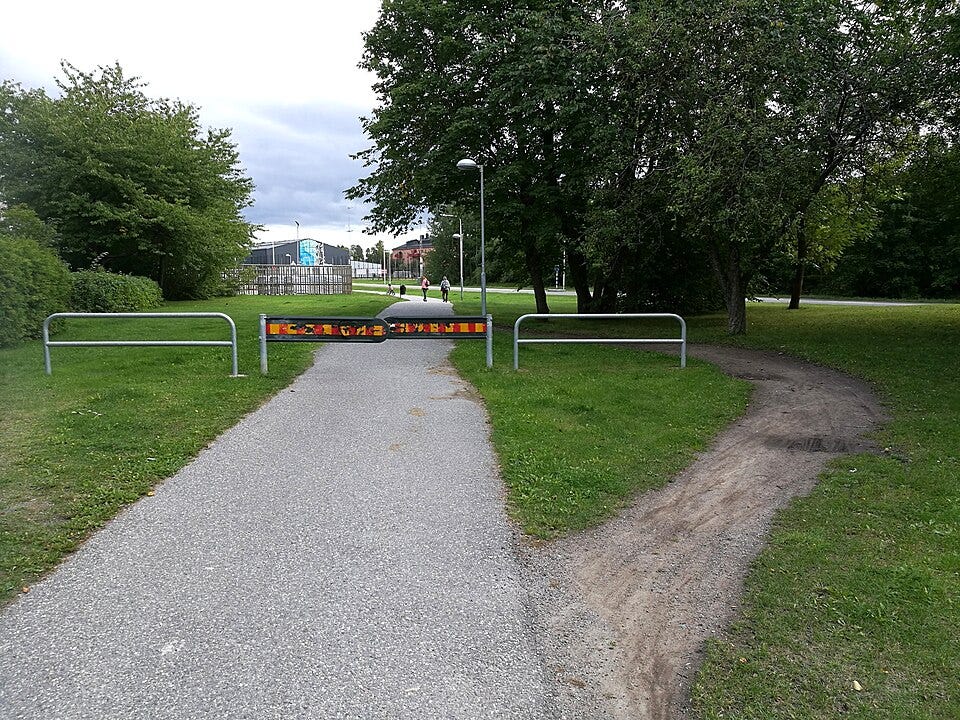
Expertise becomes the default because it is often the easiest power to develop. You can take a class from your couch. You can earn a credential on a schedule that fits around your existing job. You can read a book, complete a course, attend a workshop, and walk away with something measurable to show for your time. Expertise is concrete. It is within your control, and in a role where very little feels within your control, that matters more than most people admit.
The other three powers are harder.
Connections require other people’s time, cooperation, and reciprocity. You cannot manufacture a strong network the way you can complete a training module. Personal authority requires a different kind of work entirely: the slow, uncomfortable process of understanding how you come across, what you project, and whether the version of yourself you’re presenting to the room matches the leader you actually are. That’s not a class you can take. It’s a mirror you have to be willing to look into.
And position? Position requires someone else to say yes. You can prepare for it, advocate for it, make the case for it, but ultimately it is not yours to control. For women who have been conditioned to believe that hard work and competence are the primary currencies of advancement, that loss of control is deeply uncomfortable. So they go back to what they can control. They sign up for another certification.
This completely logical response to a system that has historically rewarded women for being excellent at their jobs while quietly failing to promote them for it is not a character flaw. The expertise trap isn’t a personal failing; it’s a pattern. And like most patterns, the first step out of it is simply seeing it clearly.
Indispensable Is Not a Compliment
Here is what the expertise trap looks like from the inside of a middle management role.
You are good at your job. Genuinely, measurably good. Your projects land well. Your team respects you. Your manager relies on you. You have become, in the language of How Women Rise, indispensable. And as it turns out, indispensable is a ceiling dressed up as a compliment.
When you are the person your team cannot function without, you become very difficult to promote. Moving you up means creating a gap that nobody knows how to fill. Your boss knows this. Somewhere, you probably know it too. But instead of addressing it directly by advocating for yourself, building the relationships that would make a transition possible, developing your team so they don’t need you quite so much, you do what feels productive. You add another skill. You take another course. You make yourself even more indispensable, and the expertise trap compounds.
This is where the four powers become useful not just as a career concept but as a diagnostic tool because the question isn’t whether or not you have expertise. You know you do. But rather, what have you been neglecting while you were busy accumulating it? Studies repeatedly show that women in the workplace are skilled at building relationships, so why isn’t the power of connection helping them advance their careers? There is a difference between being well-liked and being well-connected in the way that actually moves careers forward. One is about warmth. The other is about mutual advantage. Leveraging your relationships is the willingness to ask for what you need, offer what you have, and let relationships do the work they are capable of doing.
That distinction is uncomfortable for a lot of women. It can feel transactional. It can feel like using people. But leveraging a relationship for mutual advantage isn’t manipulation, it’s how power actually works. And refusing to do it, however virtuous it feels, keeps you exactly where you are.
The Honest Look
Before you can address the imbalance, you have to see it clearly. Consider the four powers and rate yourself honestly on each one. Where are you strong? Where are you growing? What have you overlooked?
The power of expertise - your knowledge, credentials, and technical skills.
The power of connections - not just the relationships you have, but your willingness to leverage them for mutual advantage.
The power of personal authority - how you show up, how people experience you, whether the version of yourself you present to the room matches the leader you actually are.
The power of position - the formal authority you currently hold and how intentionally you are using it.
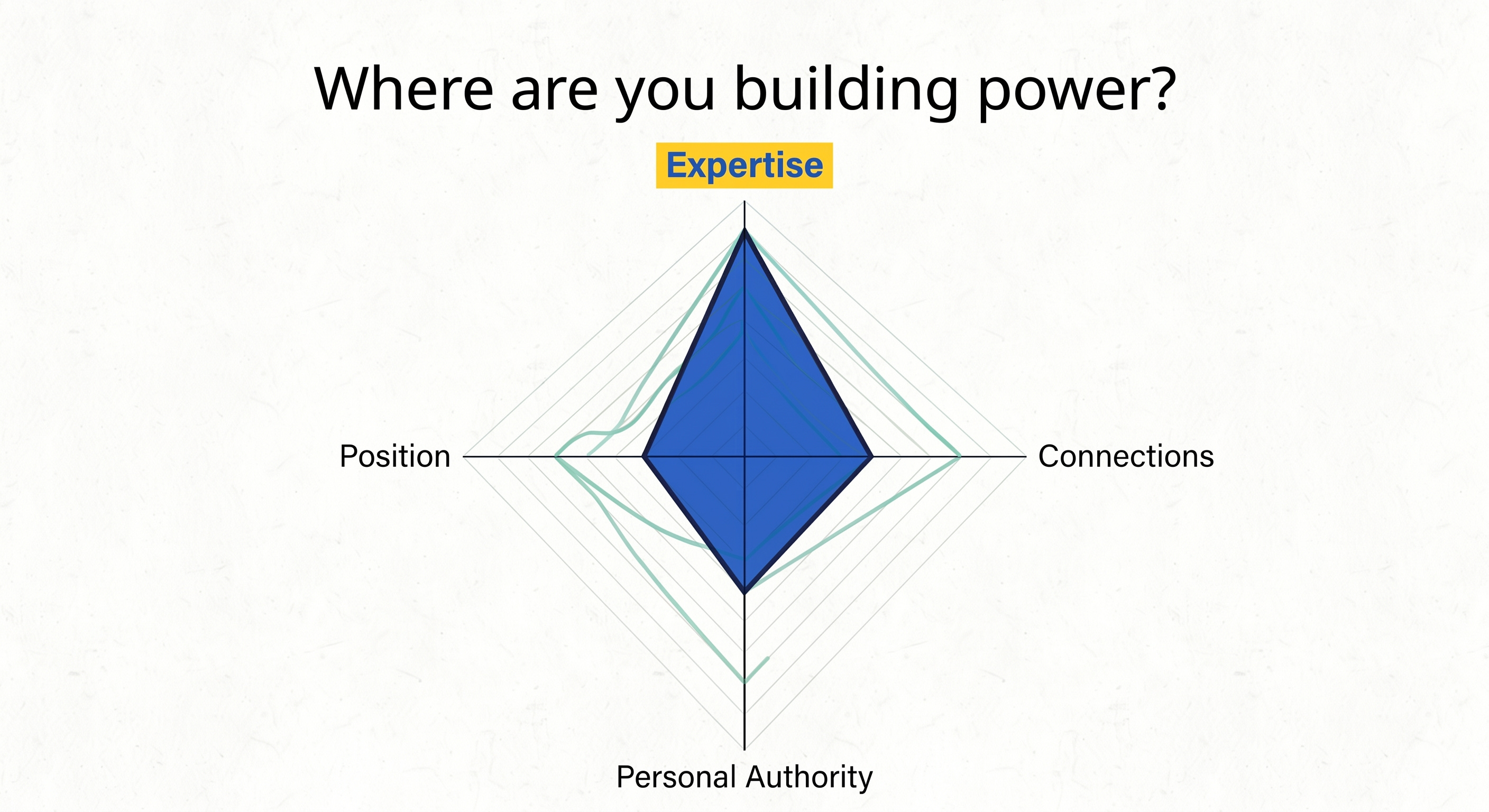
Most women reading this will say that the power of expertise is their strongest power. That’s expected when it’s the power you’ve been building longest and most deliberately. The more useful question is this: Which one feels the most uncomfortable to consider honestly? That’s where the work is.
A significant gap between your expertise and your connections is the most common pattern and the most costly one for women who want to move forward. But any gap between expertise and the other three is worth paying attention to. The goal isn’t to abandon what you’re good at. It’s to stop letting it be the only thing you’re building.
One Step in a New Direction
The certification you’re considering probably won’t hurt you. But before you sign up, it’s worth considering: is this actually the next thing I need, or is it just the most comfortable next thing available?
Expertise got you here. It is a real and necessary kind of power. But it has a ceiling, and you may already be bumping against it. The people who move forward are not always the most credentialed people in the room. They are the ones who figured out how to let their relationships do some of the work, who got comfortable being seen, who stopped waiting to feel ready enough and started asking for what they wanted. That shift doesn’t require a new certification. It requires a different kind of investment.
Reflect: Look back at your self-rating. Which power has the biggest gap from your expertise? What have you told yourself about why that power is harder to develop and is that story actually true?
Act: This week, take one step toward your most neglected power. If it’s connections, reach out to one person you’ve been meaning to contact and be specific about what you’re hoping to explore together. If it’s personal authority, say the thing in the room you’ve been keeping to yourself. If it’s position, have the conversation you’ve been avoiding about what comes next for you.
One step. Not a new curriculum. Just one step in a different direction.