

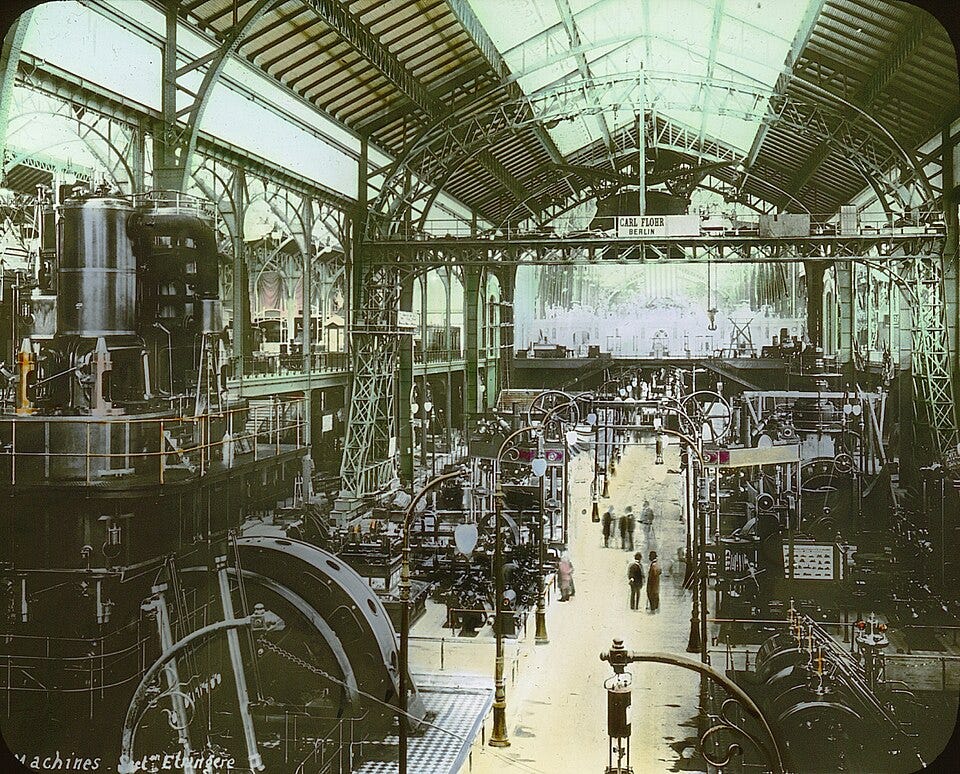
In 1900, the world came to Paris to see the future. The future was electricity. Enormous dynamos hummed at the center of the hall, electric light made the whole place glow, and people traveled from everywhere to see the spectacle. But the truth was that fewer than 5 percent of factories and homes ran on electric power.1 The spectacle was decades ahead of the real world implementation.

When factories began to switch to electricity, they did it for the promise of a smaller coal bill. They bolted electric motors onto the layout already built around steam and ran it the same old way. They didn’t start to see significant gains from electricity until they rebuilt the work itself around what the new power made possible. It took a generation. The economists who study this put the full return at forty to fifty years after the first power stations opened.2
What happened to the early adopters? Did they save money on coal? Yes, but not as much as they had hoped. They saw other gains like a smoother workflow, brighter and cleaner buildings, control over each individual machine instead of having one belt drive everything. The gains weren’t predicted, but they revolutionized the way factories function.3
Does any of this sound similar to what is happening in today’s offices? You would not be the first to ask. Economists have been drawing this exact parallel for years. Erik Brynjolfsson and his colleagues even gave the pattern a name, the productivity J-curve: when a major new technology arrives, output dips while everyone reorganizes around it, and only climbs once the reorganizing is done. AI, they argue, is in the early dip right now.4
As companies adopt AI, the promise is that it will save time and allow for more sophisticated data analysis or coding. We’re hearing that one person can do the work of several as tech companies announce layoffs.
And it’s true, AI does help to save time on some things. But if the dynamo is any guide, the obvious win is the coal bill, but the things that actually matter, the real gains and the real costs, are somewhere we’re only just now starting to look at.
But how does this affect you? A middle manager going from one day to the next, absorbing pressure from leadership to make your work AI-enhanced. Whatever that means. You find yourself checking AI-written work for hallucinations it confidently passes off as facts. You are coaching people through tools you learned yourself last week. You are translating “make it AI-enhanced” into something your team can actually deliver. The thing that was supposed to lift the weight added weight.
The Tool vs. The Transformation
Ask other managers, and you’ll likely hear the same thing. Individuals feel like they are doing work faster but very little has changed in how their company works.5 The tool (AI) is available, but the transformation isn’t complete.
In the early 1900s, someone had to redesign and rebuild the factory floor. Today, someone has to stand in the gap between the tool and the transformation and do the slow work of figuring out how everything should change. That someone is the middle manager.
In a June 2026 Harvard Business Review article, Julia Shin and Sandra Sucher interviewed people at every level of two consulting firms to see how AI adoption actually lands. They found a single pressure point. Where AI was working, the junior staff got freed for higher-value work and the partners moved to selling AI-enhanced judgment. Everyone rose except the person in the middle. In their words, “Without organizational support, managers don’t get elevated; they get buried.”6
Gallup’s 2026 State of the Global Workplace report puts numbers to the burial. Manager engagement fell from 30 percent in 2023 to 22 percent in 2025, the steepest drop of any employee group.7
And underneath it sits the gap that explains why you’re so tired. Most people using AI say it has made them personally faster. Yet, only a fraction say their organization has actually changed how it works. Gallup names the paradox plainly: “AI improves personal worker productivity, but macro-level benefits remain elusive.”8 The tool is in your hands. The transformation is stuck. And you are standing in the space between them.
The Deciding Factor
You are not a bystander to whether AI works at your company. You are the deciding factor. Gallup found that manager-led adoption is one of the two strongest drivers of whether people actually use these tools at all. When a team believes its manager genuinely backs their use of AI, that team is nearly nine times more likely to say AI has changed how their work gets done.9 The deciding factor isn’t the software or the training budget. It’s you.
Now set that next to what’s happening to your job. Manager engagement is falling faster than any other group’s. And Gartner projects that in 2026, one in five organizations will use AI to flatten their structure, cutting more than half of their middle management roles.10
Read those two facts together and the vise is complete. You are the single biggest reason AI adoption succeeds, and you are the role most likely to be eliminated in its name. You are the part holding the transition together, and the part the transition is being told it can do without.
Bolted On, or Built In?
Think back to the introduction of electricity to factories. The factories that bolted electric motors onto the old steam layout saw a modest cost savings, but they didn’t see the full impact. That impact was reserved for the factories that rebuilt their work around their new reality. It wasn’t electricity alone that made a difference. They also needed someone to redesign the work.11
AI is being adopted both ways right now, in the same economy, sometimes in the same building. So the useful question isn’t whether AI is good or overhyped. It’s this: is your organization bolting it on, or building it in? As a middle manager, you’ll know the answer to this question better than anyone.
In a bolted-on rollout, the tool arrives and nothing else moves. Your targets are the same as they were before AI existed. The time you spend learning it comes out of your own evenings, because the delivery schedule never made room. There’s no shared place to put what you figure out, so every team, including yours, keeps solving the same problem from scratch. Nobody has said what “good enough” looks like for AI work, so you’re setting that standard yourself, one deliverable at a time. And when something goes wrong, you are the quality control, the training department, and the help desk, all at once.
Built in looks different, and it’s rarer. Learning time is on the calendar, not stolen from it. There’s an actual system for capturing what works, so it travels between teams instead of dying on someone’s laptop. Leadership has said, out loud, what the tools are for and where the lines are. This is the pattern Shin and Sucher found: the teams where AI adoption compounded weren’t the ones with the best software. They were the ones that redesigned the work around it.12
When an organization hasn’t done that redesign, the work doesn’t wait politely for someone with authority to get to it. It falls to whoever is standing closest. And the person standing closest is you. So you quietly become the redesign. You absorb the missing system into your own hours. You turn yourself into the shared hub, the training program, the standards committee, and the help desk, off the side of a desk that was already full. Nobody asked you to, exactly. Nobody’s paying you for it. It doesn’t have a name on any org chart. But it’s the second job you’ve been doing since AI showed up, and it’s likely wearing you out.
Which means the question that actually helps you isn’t the one about your organization. You can’t reorganize your company from the middle. The question that helps you is the one about the line. What here is genuinely your job, and what have you been carrying because it was easier to absorb it than to watch it drop?
Reflect & Act
Reflect
Take five minutes and a piece of paper. Write down everything that landed on you when AI showed up: the checking, the coaching, the prompt-fixing, the standard-setting, the questions you field, the fires you put out, the things you quietly track so no one else has to.
Now go back through each item and ask yourself:
Is this genuinely mine to do? (This will be things like coaching your team, judgment calls that need your experience, etc.)
Is this part of the company’s unfinished redesign? (This will look like a lack of standards or AI policy, a lack of AI training, etc.)
Circle everything that falls into that second category. Then look at how much of the page is circled.
This is a picture of how much invisible reorganization you’ve been carrying without anyone deciding you should. Think about this weight on you and your team. You can’t set a boundary around something you haven’t named.
Act
You can’t redesign your company, but you can decide what you do with the circled list. Four moves, in your control:
Name one circled item out loud, upward. Pick the heaviest thing you’ve been silently absorbing and make it visible to your own manager. Not a complaint, a surfacing: “I’ve been holding the AI review standards for the whole team because we don’t have any. That’s working for now, but it’s a gap somebody above me should own.” You’re not demanding they fix it. You’re refusing to keep it invisible. Half of what buries middle managers stays buried because they absorb it quietly instead of naming it.
Stop privately being the system your org hasn’t built. You became the shared hub because there wasn’t one. So make it a real request: ask for the shared place to put what works, the half-day for the team to actually learn the tools, the standard from leadership on what “good enough” means. If the answer is no, that’s information too. It tells you the rollout is bolted on, and you can stop pretending it’s your personal failing that it feels that way.
Protect one piece of capacity and defend it like it’s load-bearing. History says that gains require protected time, and nobody hands it to you. So take it. One block a week that AI overflow doesn’t get to touch, whether that’s your own thinking time or your team’s learning time. The instinct under pressure is to give it up first. That instinct is the thing to push against.
Spend your influence on purpose. You are the biggest factor in whether this works for your team. That’s real power, and right now it’s probably leaking out everywhere, into every crisis and every question. Point it. Decide the one or two things your backing actually changes for your people, and put it there, instead of bleeding it across everything that asks.
David, "Computer and Dynamo."
David, "Computer and Dynamo."
Gallup, State of the Global Workplace: 2026 Report (Gallup, Inc., 2026). Figures cited: 65% of workers in AI-adopting organizations report higher personal productivity, while only 12% strongly agree AI has transformed how work gets done.
Gallup, State of the Global Workplace.
Gallup, State of the Global Workplace.
Gallup, State of the Global Workplace.
Gartner, as reported in Shin and Sucher, “AI Adoption.”
Shin and Sucher, "AI Adoption."